Secondary Crusher Wear Parts: Concaves, Mantles, and Cone Liners
Secondary and tertiary crushing stages operate with pre-crushed feed material at lower impact energy than primary jaw or gyratory crushing, but at significantly higher contact frequency and with more demanding product gradation requirements. The wear parts in these stages—cone crusher mantles and concaves, gyratory crusher concave segments, and vertical shaft impactor (VSI) anvil and rotor liners—must maintain their profile geometry closely throughout their service life to preserve the designed reduction ratio and product size distribution. Dimensional stability under wear is as important as total wear life in secondary and tertiary applications.
Mine Components manufactures wear parts for secondary and tertiary cone crushers, standard and short-head configurations, and gyratory crushers, in manganese steel grades optimised for secondary applications and in alloyed variants where specific feed conditions require modified material properties.
Wear Parts by Crusher Type
Cone Crusher: Mantles and Concaves
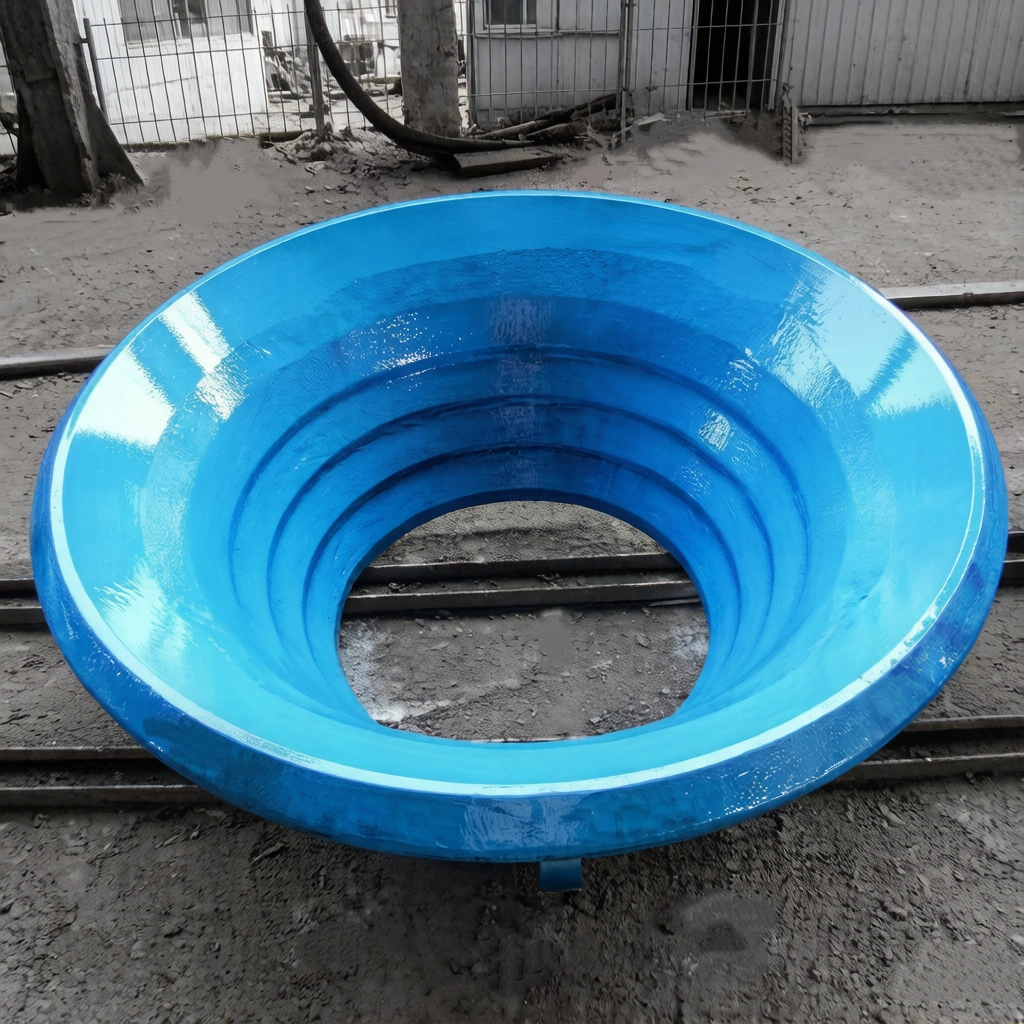
The mantle and concave are the two opposing wear surfaces in a cone crusher. The mantle rotates on the eccentric and progressively reduces material by compressing it against the stationary concave. The gap between mantle and concave at the discharge end defines the closed-side setting (CSS), which determines the product size distribution. As wear progresses, both surfaces lose material and the CSS opens unless the liner position is adjusted; at end-of-life, the liner profile has diverged sufficiently from the original geometry that consistent product gradation can no longer be maintained.
We produce mantles and concaves for standard cone crusher models in the following configurations:
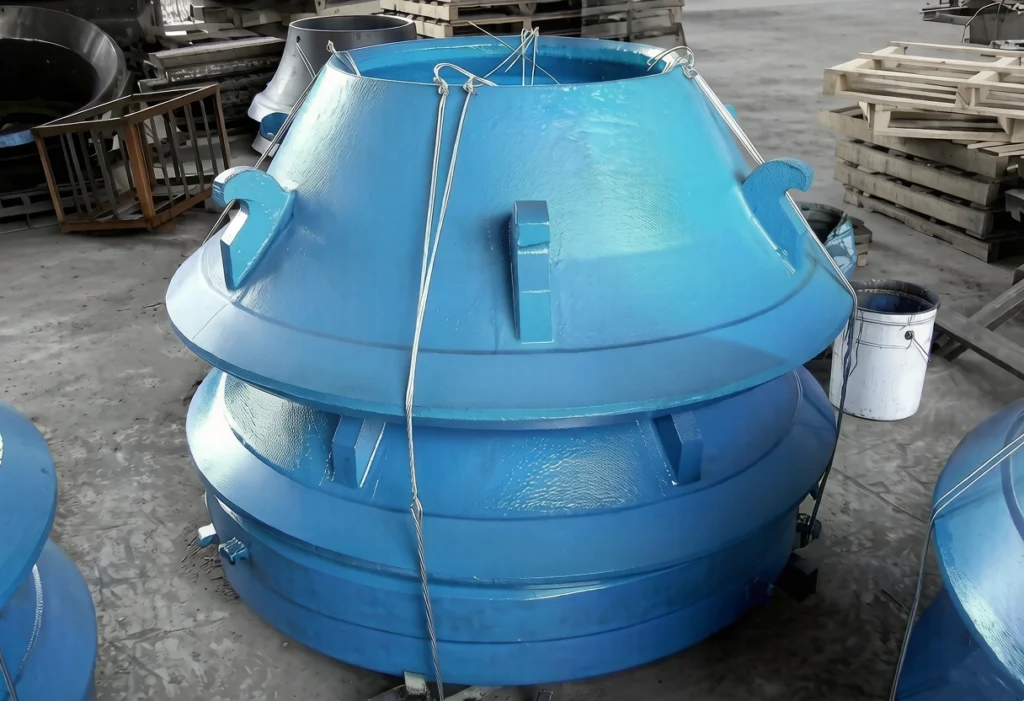
Standard (coarse) cavity — designed for feed up to the maximum feed opening of the crusher, producing a relatively coarse product. Used in secondary positions where the primary crusher product is the feed.
Medium and fine cavity (short-head) — for tertiary crushing of pre-crushed feed, producing close-graded product for aggregate or mineral processing. Fine cavity liners operate at a tighter CSS and require closer dimensional tolerance on the liner profile to maintain product specification across the liner service life.
Extra-coarse and extra-fine variants — for applications where the standard profile range does not provide the required reduction ratio or product gradation. We can produce modified cavity profiles to client specification where the OEM range has been identified as insufficient for the application.
Gyratory Crusher: Concave Segments
Primary and secondary gyratory crushers use segmented concave rings assembled in multiple tiers around the crushing chamber. Each segment is a curved manganese steel casting that, together with the other segments in its tier, forms a continuous concave surface. Segment-to-segment fit at the assembly joints is critical: a gap between adjacent segments allows material to pack into the joint and, as it is repeatedly compressed during crushing, can lever adjacent segments apart and cause premature segment loss.
We produce gyratory concave segments with machined or close-tolerance cast joint faces that assemble tightly, minimising the risk of material infiltration at segment joints. Segments are produced in matched sets with consistent profile dimensions to ensure uniform wear distribution across all segments in a tier.
VSI Crusher: Anvil and Rotor Liners
In vertical shaft impact crushers operating in rock-on-anvil configuration, the anvil ring and the anvil blocks it supports are the primary wear elements. Material thrown from the rotor at velocities of 40–70 m/s strikes the anvil surface and shatters by high-velocity impact. Anvil liner material must sustain this extremely high-energy impact without chipping while providing sufficient hardness to resist progressive abrasive wear between impact events.
We produce VSI anvil liners in manganese steel for applications where impact energy is high and anvil fracture is the limiting failure mode, and in high-chromium iron for applications where the feed is consistently sized and pre-sorted, the impact energy is lower, and abrasion wear rate is the primary limiting factor.
Material Selection for Secondary and Tertiary Applications
The material selection logic for secondary crusher wear parts differs from primary applications in one critical respect: impact energy per event is lower, which means the work-hardening response of manganese steel is less vigorous. In secondary cone crushing of medium-hard aggregate or mineral feed below 150 MPa compressive strength, standard Mn14 provides adequate performance. However, in secondary cone crushing of hard or siliceous materials—where feed compressive strength exceeds 180 MPa and silica content is above 50%—the reduced impact energy may be insufficient to fully work-harden the manganese surface, and an alloyed variant (Mn14+Cr or Mn14+Mo) with higher initial hardness may outperform standard Mn14.
We assess material selection against the crusher model, feed material characteristics, current liner service life, and observed failure mode (abrasive wear vs. thermal cracking vs. uneven profile loss) before confirming a material specification. This assessment is included at no additional cost as part of the inquiry process.
Available material grades:
Mn14 (ZGMn14) — standard grade for secondary cone crushing of medium-hard aggregate and mineral feed. Good balance of toughness and work-hardening response.
Mn18 (ZGMn18) — for applications with higher impact energy and where toughness under shock loading is prioritised, including secondary jaw crushing of hard rock and large-format gyratory concave segments.
Mn14+Cr / Mn14+Mo — alloyed variants providing higher initial hardness (250–300 HB as-cast) for applications where the work-hardening response of standard Mn14 has been identified as insufficient. Particularly effective in fine cavity tertiary cone applications where contact stress is high but impact energy is low.
Profile Accuracy and Cavity Setting
Secondary and tertiary crusher wear parts require closer dimensional control than primary jaw plates because the cavity profile directly controls the product size. A mantle or concave with incorrect cavity angle or radius will produce an off-specification product from the first hours of operation, regardless of liner material quality. We verify liner profiles dimensionally against the drawing after casting and after any machining operations, and retain profile inspection records as part of the standard quality documentation package.
For applications where the product gradation specification is tight—such as concrete aggregate or manufactured sand production—we recommend specifying a profile verification requirement at the inquiry stage to ensure the profile inspection procedure is matched to the product quality requirements.
Crusher Model Compatibility and OEM Replacement
We maintain dimensional reference data for wear parts across the major cone and gyratory crusher brands and can supply compatible replacement liners on the basis of the crusher model, cavity type designation, and current liner drawing or OEM part number. For crusher models where OEM supply has been discontinued or where OEM lead times are unacceptable, we produce compatible liners from client-supplied drawings or from worn originals subject to dimensional condition.
All client drawings and technical specifications are handled under NDA. We do not share client part geometry with third parties.
Quality Assurance and Documentation
Each delivery includes: chemical composition certificate per heat, hardness test results, dimensional inspection records with profile verification data, heat treatment records (solution anneal and quench curves for manganese steel), and batch traceability. Third-party pre-shipment inspection can be accommodated.
Ordering and Lead Times
Standard cone crusher mantles and concaves for common crusher models: 3–5 weeks. Large gyratory concave segment sets and custom profiles: 5–8 weeks. For scheduled liner change campaigns, confirming the order 6–8 weeks in advance of the planned maintenance date ensures availability without relying on expedite scheduling.
Request a Quote for Secondary Crusher Wear Parts →
Related Crusher Wear Parts
Clients operating multi-stage crushing circuits typically source Jaw Plates for the primary stage, secondary crusher liners from this page, and Impact Plates and Crusher Hammers for impact crushing stages. Complete wear part supply for a crushing circuit can be consolidated through Mine Components in a single procurement. See the Crushing Systems application page for a system-level overview.