What Working with an OEM Supplier Actually Requires — and Whether We Can Meet It
Supplying components to an OEM is different from selling standard products to a distributor or end user. The OEM’s product carries its name and reputation; the components inside it either support or undermine both. The requirements that follow from this — proprietary drawing confidentiality, first-article approval before volume production, drawing revision traceability, consistent quality across production batches over years of supply — are not bureaucratic overhead. They are the minimum conditions for a supply relationship that functions.
We have been supplying components to mining equipment OEMs under these conditions for an extended period. This page describes how we work with OEM clients — what we do, what we expect, and what a new supply relationship with us looks like in practice.
Confidentiality and NDA
Proprietary component drawings represent significant engineering investment. We treat them as such. NDA execution prior to any drawing review or technical discussion is standard practice for all OEM enquiries — not a negotiation point. Proprietary geometries are not supplied to competing clients. Production tooling made to a client’s proprietary design is not used for any other purpose without the client’s written consent.
Where a client requires their supplier base to maintain confidentiality not just of drawings but of the supply relationship itself — because the identity of their component sources is commercially sensitive — we respect that requirement. We describe our OEM supply experience in terms of capability and duration without disclosing client identities.
Qualification Process
For a new component, the qualification sequence is straightforward:
Drawing review and engineering assessment. We review the drawing for manufacturability, identify any features that require clarification or that present production risk, and confirm the material specification and heat treatment requirements. If anything in the drawing raises a question, we raise it before quoting — not after the first article fails.
NDA execution. Signed before detailed drawing review if not already in place.
Quotation and process plan. Quotation includes material grade, process route, heat treatment specification, inspection plan, and lead time for first article and subsequent volume production. For components with complex inspection requirements or special testing, the inspection plan is submitted with the quotation for the client’s review.
First-article production and inspection. The first production component is inspected to all drawing requirements — dimensions, geometric tolerances, surface condition, hardness, and any specified NDT or mechanical testing. A first-article inspection report documenting actual measured values (not pass/fail summaries) against every drawing requirement is submitted for the client’s engineering team to review and approve before volume production.
Volume production under approved process. Volume production follows the approved process without deviation. Any process change — material substitution, tooling change, subcontractor change — requires the client’s approval before implementation, not retrospective notification.
Drawing Revision Control
OEM components evolve. Drawing revisions happen — sometimes frequently in the early stages of a new product, less frequently as the design matures. Our drawing control system maintains the current approved revision for each component, flags superseded revisions, and ensures that production always runs to the current approved drawing. Revision history is retained.
When a client issues a drawing revision, we review it for production impact — whether the change affects tooling, process, or inspection — and confirm the implementation date. We do not mix revision levels in a production batch. If a batch is in progress when a revision is received, we complete the batch to the current revision and implement the revision on the next batch, with clear documentation of which revision applies to which batch.
Supply Continuity
An OEM supply relationship has a different time horizon than a project order. Components that go into a product line will be needed for the life of that product line — which, for mining equipment, can be decades. Supply continuity — the ability to keep delivering the same component to the same specification over time — is as important as the quality of the initial delivery.
We maintain production records, tooling, and approved process documentation for active OEM components indefinitely. When tooling wears and requires replacement, we produce replacement tooling to the same dimensions and validate it against the approved first-article before returning to volume production. When material grades change — because a mill specification is revised or a source becomes unavailable — we qualify the replacement material to the same mechanical property requirements before using it in production.
We have maintained continuous supply relationships with mining equipment OEMs over periods of five years and longer. The relationships that work are ones where both parties treat the supply arrangement as a long-term engineering partnership rather than a series of individual purchase orders.
What We Supply to OEMs
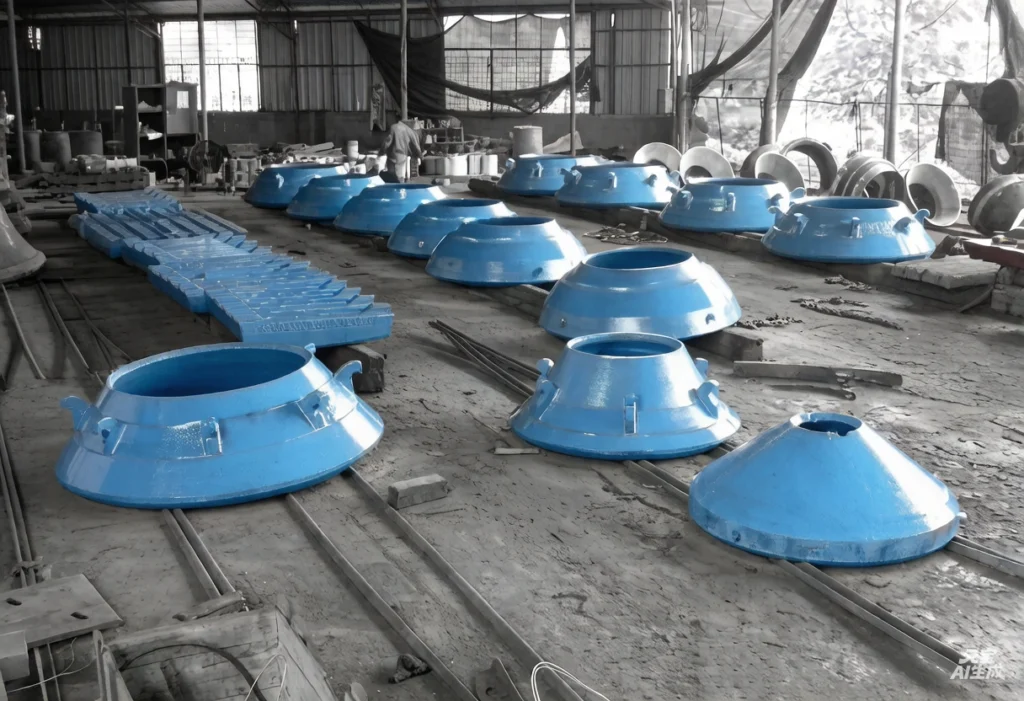
The range of components we supply under OEM agreements spans our full manufacturing capability: cast wear parts to proprietary liner profiles, forged structural and transmission components for underground coal equipment, precision machined housings and carriers for mining gearboxes, and structural fabricated components produced to proprietary designs. The common thread is not component type but the requirement for consistent quality, drawing conformance, and supply continuity over time.
We do not supply everything to everyone. Where our manufacturing capability does not match a component’s requirements — in material, process, scale, or precision — we say so at the enquiry stage rather than after a failed first article.
To discuss OEM supply requirements or begin the enquiry process, contact our engineering team. NDA can be executed promptly for clients who wish to proceed to drawing review.