Toothed Crusher Rollers for Roll Crushers and Sizer Crushers
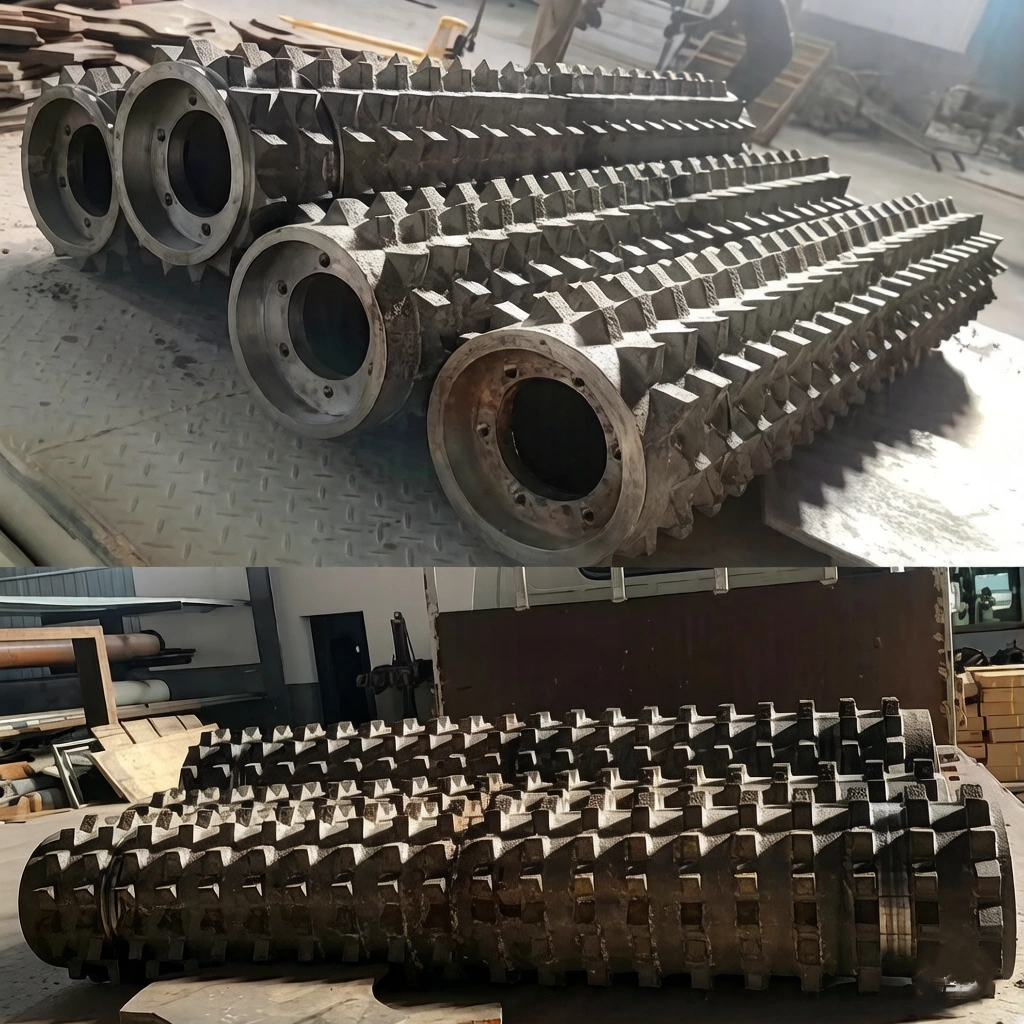
Toothed crusher rollers are the primary size-reduction elements in double roll crushers, mineral sizer crushers, and rotary breakers. The roller body carries an array of crushing teeth that engage feed material through a combination of compression, shear, and tensile fracture — a fundamentally different breakage mechanism from the impact-dominated action of hammer mills or jaw crushers. This makes toothed rollers particularly effective for friable and moderately hard materials where controlled product size distribution and low fines generation are priorities.
Mine Components manufactures toothed crusher rollers in cast manganese steel and alloy steel grades, covering roller diameters from 400 mm to over 1,200 mm and roller body lengths from 600 mm to 2,500 mm. We supply complete roller assemblies and individual replacement components to roll crusher operators and OEM equipment manufacturers across double roll crusher and mineral sizer platforms.
Applications and Feed Materials
Toothed crusher rollers are used across a range of industries where controlled fracture of friable or medium-hard material is required:
Coal crushing — primary and secondary crushing of run-of-mine coal for preparation plant feed, sized coal production, and thermal coal processing. Coal’s relatively low compressive strength and cleating structure respond well to the shear-dominant breakage of toothed rollers, producing a coarser product size distribution with fewer fines than impact crushing.
Coke and sinter — crushing of metallurgical coke and iron ore sinter for blast furnace burden preparation. Both materials are brittle and abrasive; tooth geometry and material grade selection are critical to managing tooth wear rate.
Limestone and soft rock — secondary and tertiary crushing of limestone, chalk, and similar sedimentary materials for aggregate and cement raw material production.
Potash, salt, and evaporite minerals — size reduction of soluble minerals where the product sensitivity to fines and moisture makes impact crushing impractical.
Oil sands and mineral sands — lump size reduction for downstream separation and processing.
Fertilizer raw materials — crushing of phosphate rock, potassium chloride, and similar soft to medium-hard feed materials.
Roller Construction and Tooth Geometry
A toothed crusher roller consists of a central shaft or hollow drum body, end flanges for shaft mounting and drive connection, and the crushing tooth array distributed across the roller surface. Tooth geometry — height, pitch, face angle, and tip profile — determines the bite angle, the maximum particle size that can be nipped, and the product size distribution.
Pyramid and chisel teeth — the most widely used geometry for coal and coke crushing. Pyramid teeth provide structural strength at the base and a defined point or ridge at the tip for penetrating the feed material surface. Chisel-profile tips are used where a shearing action is preferred over pure compression.
Pick-type and replaceable teeth — used in sizer crushers and rotary breakers where high tooth-to-material contact force is required. Pick geometry concentrates force at a small contact area and is more effective for materials with embedded hard layers or variable hardness. Replaceable pick inserts allow individual tooth replacement without removing the roller from service.
Segmented tooth blocks — bolt-on tooth segments that can be replaced individually as they wear, extending the service life of the roller body and reducing maintenance cost per tonne crushed.
Staggered and helical tooth patterns — tooth rows are offset between adjacent rows to distribute crushing load across the roller face and prevent ridging in the product. Helical patterns provide continuous engagement across the roller width and reduce shock loading on the drive train.
We produce rollers to client tooth geometry from drawings or from a worn original, and can advise on tooth geometry modifications where service life or product gradation performance has been identified as insufficient.
Material Grades and Selection
Tooth and roller body material selection depends on feed material hardness, the dominant wear mechanism, and required toughness under impact loading:
| Grade | Typical Composition | Best Application |
|---|---|---|
| Mn14 (ZGMn14) | C 1.0–1.3%, Mn 13–16% | Coal, coke, soft rock — good toughness and work-hardening response under repeated impact |
| Mn18 (ZGMn18) | C 1.1–1.4%, Mn 17–19% | High-energy primary crushing, large-diameter rollers, low-temperature environments |
| Cr-Mo alloy steel | Mn14 base + Cr/Mo additions | Hard abrasive feeds above 80 MPa compressive strength where Mn14 work-hardening is insufficient |
| Composite insert | Carbide or hard alloy tooth tips in steel body | Applications where tooth wear rate is the dominant performance limitation |
Material selection is confirmed as part of the inquiry process based on crusher model, feed material characterisation, and current roller service life data. We do not apply a standard grade without reviewing the application.
Manufacturing Process
Pattern and tooling — roller tooth geometry is reproduced from client drawings or reverse-engineered from worn originals provided by the client. Pattern tooling is produced in-house for custom orders, ensuring dimensional control is established at the tooling stage.
Casting and forging — roller bodies and integral tooth arrays are produced by sand casting or resin sand casting depending on geometry and dimensional tolerance requirements. Shaft and hub components requiring higher mechanical strength are produced by open-die forging.
Heat treatment — manganese steel rollers undergo solution annealing at 1,050–1,100°C followed by water quenching to produce a fully austenitic microstructure. Alloy steel variants are quenched and tempered to the specified hardness range. Heat treatment records are retained per batch.
Machining — shaft bores, keyways, end flange faces, and drive connection features are finish-machined after heat treatment. Dimensional accuracy of the shaft interface is critical to roller balance and bearing service life. All critical dimensions are controlled to drawing tolerances using calibrated CNC equipment.
Dimensional and hardness verification — finished rollers are inspected against drawing tolerances. Hardness is verified at multiple points across the tooth array and roller body. Results are recorded in the inspection report accompanying each delivery.
Quality Assurance and Documentation
Each roller delivery is supported by a full documentation package: chemical composition certificate per heat, hardness test results across the tooth array and roller body, dimensional inspection records against drawing, heat treatment time-temperature curves and quench records, and batch traceability documentation. Non-destructive testing by magnetic particle inspection (MPI) or ultrasonic testing (UT) is available on request and can be specified as a standard requirement for high-value or safety-critical orders.
Third-party pre-shipment inspection through SGS, Bureau Veritas, or the client’s nominated inspector can be accommodated at the pre-shipment stage.
OEM Supply and Crusher Model Compatibility
We maintain dimensional reference data for toothed rollers across major double roll crusher and mineral sizer platforms and can supply compatible replacement rollers on the basis of crusher model, roller diameter and length, shaft specification, and tooth geometry drawing or OEM part number.
For crusher models where OEM supply has been discontinued or where OEM lead times are unacceptable, we produce compatible rollers from client-supplied drawings or from worn originals subject to dimensional condition.
For OEM equipment manufacturers requiring consistent repeat supply under drawing control, we operate under NDA and maintain approved process documentation for active roller specifications. All client drawings and technical specifications are handled under confidentiality agreement as standard.
Ordering and Lead Times
Standard toothed crusher rollers for common crusher models: 4–6 weeks from drawing confirmation. Large-diameter rollers above 800 mm or custom tooth geometry requiring new pattern production: 6–10 weeks depending on casting schedule and heat treatment. Indicative lead times are confirmed at the inquiry stage once the roller specification is established.
To place an inquiry, provide the crusher model, roller diameter and length, shaft specification, tooth geometry drawing or OEM part number, required quantity, and any material or documentation requirements.
Request a Quote for Toothed Crusher Rollers →
Related Crusher Wear Parts
Clients sourcing toothed crusher rollers also commonly require Jaw Plates for primary crushing stages, Crusher Hammers and Impact Plates for impact crushing circuits, and Secondary Crusher Wear Parts for downstream cone and gyratory crushing. Complete wear part supply for a multi-stage crushing circuit can be consolidated through Mine Components in a single procurement. See the Crushing Systems application page for a system-level overview.